
Landscape lighting transforms a yard from a dark void into an inviting outdoor space, yet most homeowners assume it requires a contractor’s budget and a professional’s expertise. The truth? Modern affordable landscape lighting has evolved dramatically. Today’s solar-powered and LED options deliver professional-looking results without the thousand-dollar price tag. Whether someone wants to highlight a pathway, accentuate garden beds, or create ambiance for entertaining, budget-friendly solutions are genuinely within reach. This guide walks through the most cost-effective options, installation strategies, and common pitfalls so that any homeowner can light up their yard without very costly.
Table of Contents
ToggleKey Takeaways
- Affordable landscape lighting using solar and LED options can transform your yard for under $500 without requiring professional contractors or expensive electrical work.
- Solar-powered lights offer the lowest cost entry point at $3–$8 per unit but work best for accent lighting in sunny areas, while LED systems provide superior brightness and longevity for primary pathways and security.
- DIY installation of landscape lighting eliminates labor costs by running 12-gauge low-voltage wire yourself—a flat spade and basic tools are sufficient for most residential yards.
- Invest in quality components like sealed solar batteries, proper 12-gauge wire gauge, and appropriately-sized transformers to avoid common failures; cheap materials often fail within one season.
- Beyond aesthetics, landscape lighting improves safety by eliminating tripping hazards, enhances property security, and can increase home resale value and curb appeal.
Why Landscape Lighting Matters More Than You Think
Landscape lighting does far more than make a yard look nice. It fundamentally changes how a property functions and feels, especially after dark.
Safety is the primary reason. Well-placed lighting eliminates tripping hazards on stairs, walkways, and uneven terrain. It also deters unwanted activity around the home: a lit perimeter signals that the property is occupied and monitored. Many insurance policies even recognize exterior lighting as a security feature.
Second, landscape lighting extends the usable season of an outdoor space. A homeowner can entertain on the patio in summer evenings or simply enjoy their yard without retreating indoors at dusk. That added functionality translates directly to property value, studies consistently show that outdoor lighting improvements boost curb appeal and resale perception.
Third, it’s relatively low-maintenance compared to other outdoor upgrades. Unlike a deck or patio, landscape lighting requires minimal seasonal work once installed. A little debris cleanup and the occasional bulb replacement is all it takes.
Budget-Friendly Landscape Lighting Options to Consider
The landscape lighting market has shifted dramatically toward affordable, energy-efficient solutions. Two categories dominate the budget-conscious market: solar-powered and LED systems. Understanding the strengths of each helps homeowners make the right choice.
Solar-Powered Lights
Solar lights are the lowest-cost entry point for affordable landscape lighting. They contain a small photovoltaic panel, a rechargeable battery, and an LED, all in one self-contained unit. No wiring, no trenching, no electrician required.
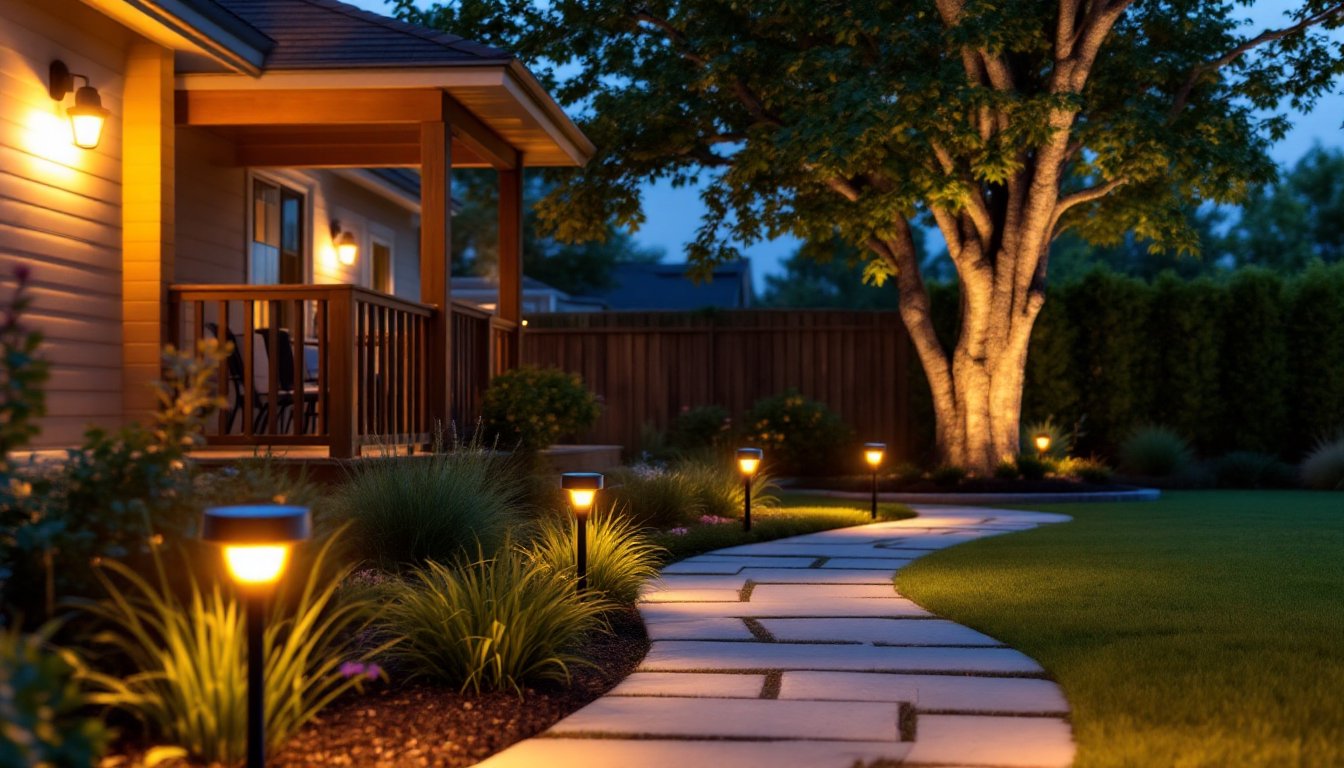
The main appeal is simplicity. A homeowner stakes a solar light into the ground, and it charges during the day and illuminates at night. A basic solar path light costs $3–$8 per unit, making a dozen lights a $50 investment rather than a few hundred. For a rental property or a trial run, solar lights are nearly risk-free.
The trade-off is brightness and consistency. Solar lights rely on daily charging, so cloudy regions see reduced performance. Battery life typically ranges from 6–10 hours nightly, which is plenty for accent lighting but not for primary pathways in heavy-use areas. After 2–3 years, batteries degrade and lights dim, replacement is often cheaper than repair.
Solar uplights (taller stakes with wider beam patterns) and solar spotlights work well for accent lighting around trees or architectural features. They’re ideal for supplementary lighting in well-draining soil and sunny locations.
LED Landscape Lights
LED lights powered by low-voltage electrical systems cost more upfront but deliver superior brightness and longevity. A typical 12-volt LED pathway light runs $15–$30 per unit, but the system includes a transformer, wiring, and a controller, so total project cost scales differently than solar.
The advantage here is consistency. LED lights operate on a fixed schedule, regardless of weather or season. They’re significantly brighter than solar equivalents, so they work better for primary walkways and safety-critical areas. LED bulbs last 25,000–50,000 hours (roughly 10–15 years of nightly use), far longer than solar batteries.
Installation requires running 12-gauge wire (low-voltage cable, not line-voltage) from a transformer near the home’s electrical outlet to the light fixtures. Most homeowners can bury the wire 6–8 inches deep without a permit, though local codes vary. No trenching equipment is needed: a flat spade does the job. The transformer plugs into an outdoor outlet (or an electrician can hardwire it, budget $200–$500 for professional installation if needed).
LED systems are more flexible for layered lighting design. A homeowner can install accent, ambient, and task lighting all on the same circuit, controlled by a single timer or photocell.
Step-by-Step Installation Tips for DIY Savings
Installing affordable landscape lighting yourself eliminates labor costs, often the biggest expense in a professional quote. Here’s how to do it right.
For Solar Lights:
- Choose locations that receive at least 6 hours of direct sunlight daily. Avoid shaded areas under trees or overhangs: they won’t charge properly.
- Clear grass and debris from the stake area. Compact soil actually helps: loose soil makes the stake wobble.
- Push the stake straight down, twisting gently if soil is hard-packed. A rubber mallet helps without damaging the light.
- Activate the on/off switch (most solar lights ship with a tab in the battery compartment) and let them charge for a full day before expecting full brightness.
For Low-Voltage LED Lights:
- Map the circuit layout on paper. Measure from the power source (outlet or transformer location) to each light, noting total wire length.
- Purchase the correct gauge wire, 12-gauge is standard for most residential setups and carries enough amperage without voltage drop over typical yard distances (under 100 feet). Thinner wire (14-gauge or 16-gauge) causes dimming at the far end.
- Run the wire along the path where lights will install. For concealment, bury it 6–8 inches deep along planting beds or under mulch. Avoid direct foot traffic areas: the low voltage is safe, but crushing the wire can damage insulation.
- Attach fixtures per manufacturer instructions, most use simple compression connectors that pierce the wire insulation. No stripping required.
- Connect the final length of wire to the transformer, plug in, set the timer, and test all lights before backfilling.
Key prep work: Clear the installation area of rocks and roots beforehand. Level uneven patches where lights will sit: a tilted fixture casts light in the wrong direction. Acclimate materials to outdoor temperature for a day if possible: cold contractile wire is harder to work with.
Where to Buy Affordable Landscape Lighting
Sourcing is half the battle when chasing affordable prices. Homeowners have several reliable channels.
Home improvement stores (The Home Depot, Lowe’s) stock both solar and LED options at competitive prices. Selection is broad, return policies are forgiving, and local availability means no shipping costs on heavy items like transformers. Sales cycles are predictable, spring and early summer see discounts as demand peaks.
Online retailers like Amazon offer deeper discounts on bulk solar lights and specialty LED fixtures. Shipping can eat savings on heavy items, so compare total cost including delivery. Read reviews carefully: some budget solar lights fail within a season.
Lighting specialty retailers often seem pricier but sometimes match or beat big-box pricing on specific items, and staff knowledge is usually higher. Worth a call if a project has unusual requirements.
End-of-season clearance (late August through September) offers the deepest discounts. Retailers discount outdoor lighting heavily as weather cools. A patient homeowner can stock up for next year’s expansion at 40–50% off.
Budget $200–$500 for a moderate yard with mixed solar and LED lighting. Small properties (front walkway only) can stay under $100: larger installations with all LED wiring might hit $800–$1,200 before professional labor.
Common Mistakes to Avoid When Shopping for Cheap Lighting
Cutting corners on landscape lighting often backfires. Here’s what to avoid.
Don’t assume all solar lights are equal. Budget solar lights under $3 rarely last more than one season. They’re prone to water intrusion and battery failure. Expect to pay $8–$12 for solar lights with sealed, replaceable batteries and corrosion-resistant housings. Better components cost more upfront but outlast cheap alternatives.
Avoid oversized or undersized wire. Homeowners sometimes buy the cheapest wire available, often 16-gauge or even thinner. Over longer runs, thin wire causes excessive voltage drop, leaving fixtures at the far end dim or non-functional. Stick with 12-gauge for runs under 100 feet. It costs $0.50–$1.00 per foot more but ensures uniform brightness.
Don’t skip the photocell or timer. A transformer without automatic controls wastes energy and requires manual switching. A $20 photocell or built-in timer eliminates that, lights turn on at dusk and off at dawn automatically. It’s a small investment with real convenience and savings.
Resist cheap transformers. An undersized transformer (one that can’t deliver rated wattage to all fixtures at full brightness) will frustrate any homeowner. Match the transformer’s wattage rating to the total wattage of all lights on the circuit. A 60-watt transformer is overkill for a few path lights: a 300-watt transformer is appropriate for a mixed accent and pathway setup.
Don’t neglect drainage and weatherproofing. Landscape lighting sits outdoors year-round. Fixtures in low-lying areas prone to standing water will fail prematurely. Burial depth matters too, too shallow and frost heave pushes lights out of level. Aim for 6–8 inches with good drainage around the hole.
Final Thoughts
Affordable landscape lighting isn’t about choosing the cheapest option, it’s about choosing smart. Solar lights suit supplementary accent lighting and low-stakes areas: LED systems deliver the consistency and brightness that primary pathways and security zones require. Installation is straightforward for most homeowners, and planning ahead eliminates costly mistakes. With careful material selection and proper prep work, a homeowner can create a well-lit yard for under $500 and enjoy it for years without regret.