
Getting bathroom vanity lighting right transforms both function and aesthetics. Proper lighting around the mirror sets the tone for grooming tasks, whether shaving, applying makeup, or general hygiene, while also influencing the entire room’s feel. Many DIYers and homeowners overlook vanity lighting during remodels, settling for whatever was already there or grabbing the first option at the hardware store. The reality is that choosing the right bathroom vanity lighting fixtures depends on understanding fixture types, sizing, placement, color temperature, and how a specific style complements the bathroom’s overall design. This guide walks through those decisions so a homeowner can confidently select fixtures that work, look good, and last.
Table of Contents
ToggleKey Takeaways
- Bathroom vanity lighting fixtures come in three main types—wall sconces, ceiling-mounted lights, and pendant fixtures—each offering distinct advantages in light distribution and aesthetic impact.
- Optimal sconce placement is 36 to 40 inches above the countertop and 24 to 36 inches apart to eliminate shadows and provide flattering task lighting for grooming.
- Neutral white light at 4000K is the best color temperature for bathroom vanities, providing accurate color rendering for makeup application and skin visibility.
- Choose vanity lighting fixtures that are 50 to 75 percent of your mirror’s width to maintain proper visual balance and ensure adequate illumination across the entire mirror.
- Select fixtures with wet-location ratings (IP44 or higher) and high Color Rendering Index (90+ CRI) to prevent corrosion in humid bathrooms and ensure skin tones and makeup colors appear true.
- Match vanity lighting finishes to existing faucets and mirror frames—coordinate with one primary finish to create a cohesive bathroom design without visual clutter.
Types Of Bathroom Vanity Lighting Fixtures
Bathroom vanity lighting falls into a handful of distinct categories, each with its own installation requirements, light distribution, and aesthetic impact. Understanding these types helps narrow the field before worrying about style or finish.
Sconce Lights And Wall-Mounted Options
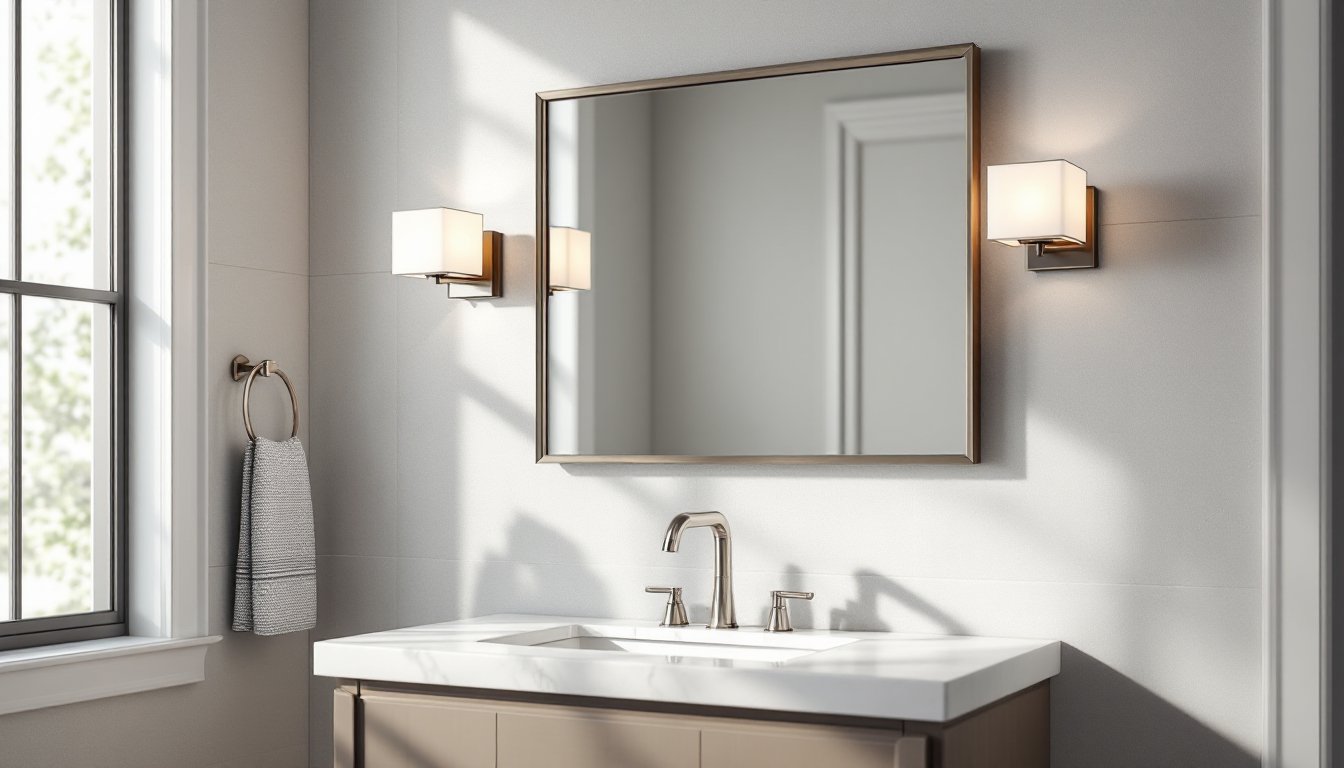
Sconces are individual light fixtures mounted directly to the wall on either side of the mirror. They’re the standard choice in most bathrooms, and for good reason: they deliver flattering, shadow-free light across the face and neck when installed at the correct height. A pair of sconces, one on each side of the mirror, is ideal. They work well in smaller bathrooms where ceiling space is limited and give homeowners flexibility in finish, size, and design direction.
Wall-mounted sconces typically use E26 (standard) or E14 (candelabra) bulb bases and can accommodate incandescent, LED, or halogen sources. Installation involves running electrical wire (usually 14/2 or 12/2 NM cable, depending on circuit load) through the wall to the fixture junction box, which anchors to a stud or uses heavy-duty drywall anchors. Some sconces accept a single bulb: others hold two or three, offering more light output. Finish options range from chrome and nickel to oil-rubbed bronze, brushed gold, and matte black, matching almost any bathroom decor.
One advantage: existing vanity walls often already have electrical roughed in behind the mirror, so retrofitting sconces is straightforward if you’re willing to patch and repaint surrounding drywall. The downside is that sconces cast light from the sides, which can create shadows if placed too close to or too far from the mirror.
Overhead And Ceiling-Based Fixtures
Ceiling-mounted vanity lights hang or mount flush to the ceiling directly above the mirror. These deliver downward-directed light and work well in bathrooms where wall space beside the mirror is limited, or where the mirror is wide and needs balanced illumination across its entire width.
Common ceiling-based options include flush-mount fixtures, semi-flush mounts, and pendant lights. Flush-mount fixtures sit nearly flush with the ceiling, making them ideal for low-clearance bathrooms (7.5 to 8 feet of ceiling height is standard in most homes). Semi-flush fixtures hang 6 to 12 inches below the ceiling and offer a bit more decorative presence. Pendant lights hang on a chain or stem and create a more dramatic, sometimes industrial or modern aesthetic.
Ceiling fixtures require existing electrical (junction box) in the ceiling above the mirror or routing new wire through the attic or basement, depending on house framing. They work best when positioned 24 to 30 inches above the vanity countertop, ensuring light spreads across the mirror without glare on the glass. Multiple smaller ceiling fixtures or a longer strip-style light can distribute illumination more evenly than a single central light.
One consideration: overhead lights alone can cast unflattering shadows on the face and are often why homeowners supplement them with wall sconces for better task lighting.
Key Factors To Consider When Selecting Fixtures
Beyond fixture type, several technical and practical factors determine whether vanity lighting performs well and integrates smoothly into a bathroom renovation or update.
Sizing And Placement For Optimal Lighting
Vanity fixture sizing starts with mirror width. The rule of thumb is to choose fixtures that are roughly 50 to 75 percent of the mirror’s width. A 36-inch-wide mirror pairs well with sconces that are about 18 to 24 inches wide combined, or a single ceiling fixture 18 to 24 inches in diameter. Undersized fixtures look lost: oversized ones dominate the wall and obstruct sight lines.
Placement is equally critical. For wall sconces, position them 36 to 40 inches above the finished vanity countertop and 24 to 36 inches apart (center to center). This height ensures light rakes across the face without shining directly into the eyes, and the spacing avoids harsh shadows down the center of the face. Too high and light skims over the top of the head: too low and shadows pool under the eyes.
For overhead fixtures, mount them 24 to 30 inches above the countertop and centered over the mirror. If using two smaller ceiling fixtures instead of one large one, space them 12 to 18 inches apart to eliminate a dark line down the middle of the mirror.
Circuit capacity and bulb wattage matter too. A typical bathroom circuit is 20 amps at 120 volts, enough for multiple sconces or a ceiling fixture plus other devices (exhaust fan, heated mirror, outlets). LED bulbs draw minimal power, so they’re compatible with nearly any existing circuit. Older incandescent or halogen fixtures may pull 40 to 60 watts each: verify the fixture’s rating before installing multiple units on the same circuit.
Light Temperature And Color Rendering
Color temperature, measured in Kelvin (K), determines whether vanity light feels warm, neutral, or cool. This affects how the user looks in the mirror and how the bathroom feels overall.
Warm white light (2700K) is yellowish, flattering to skin tone, and popular in bedrooms and living spaces. But, in a bathroom, it can mask skin problems and make color-matching makeup difficult.
Neutral white light (4000K) is balanced and accurate. It’s widely considered the best choice for bathroom vanities because it provides true color rendering without skewing warmth or cool tones. Makeup looks realistic, blemishes and discoloration are visible, and the bathroom feels clean without being harsh.
Cool white or daylight light (5000K–6500K) mimics natural daylight and is ideal for task-intensive grooming. Some users prefer it: others find it too clinical. If using it, verify that the fixture and bulbs are rated for damp or wet locations (IP44 rating or higher) and that the bulb produces sufficient lux (foot-candles) at the mirror, typically 50 to 70 foot-candles for adequate task lighting.
Color Rendering Index (CRI) is another spec worth checking. CRI measures how accurately a light source renders colors on a scale of 0 to 100. Most LED and quality incandescent bulbs score 80 or higher: choose 90+ CRI for vanity lighting to ensure skin tone and makeup colors look true. Cheap LEDs with low CRI (70 or below) can make skin appear sallow or makeup colors shift unexpectedly.
Design Styles And Aesthetic Appeal
Style and finish anchor vanity lighting to the bathroom’s overall design language. A bathroom is a small, intimate space: the fixtures you choose set its visual tone.
Modern and minimalist bathrooms suit sleek, geometric sconces or flush-mount ceiling lights in matte black, brushed nickel, or matte white. Look for clean lines, minimal ornamentation, and fixtures that blend into the wall or ceiling rather than draw attention.
Transitional designs, a blend of modern and traditional, pair well with fixtures that balance simplicity with subtle detail. Brushed gold, champagne bronze, or satin nickel finishes work: think understated curves or soft rectangular shapes rather than ornate details.
Traditional and classic bathrooms lean toward brass, bronze, or chrome finishes with some decorative detail, lantern-style sconces, crystal accents, or vintage-inspired designs. These fixtures become focal points and coordinate with marble or ceramic tile and classic vanity cabinetry.
Industrial and farmhouse styles embrace exposed bulbs, metal cages, metal rods supporting pendant lights, or vintage Edison-style bulbs. Finish choices are typically matte black, raw iron, or weathered bronze.
When selecting a finish, consider the mirror frame and faucet finishes in the same bathroom. Mixing two finishes (e.g., chrome fixtures and brushed gold faucet) is possible with intentional design: three or more mismatched metals can feel chaotic. If the bathroom has existing fixtures, coordinate the vanity lighting to those finishes first.
Bulb type also affects aesthetics. Shaded fixtures hide the bulb and diffuse light evenly: open-frame or minimalist designs expose the bulb, so choose quality LED or decorative vintage-style bulbs that look intentional. A fixture rated for LED will perform best with modern LED bulbs, they’re dimmable, long-lasting, and energy-efficient.
Finally, consider ventilation and moisture. Bathrooms generate humidity, especially during and after showers. Choose fixtures with wet-location or damp-location ratings (IP44 or higher) to prevent corrosion and electrical hazards. Many quality fixtures carry UL or ETL listings confirming they’re safe for bathroom use. Avoid bare incandescent bulbs directly above the sink if the fixture isn’t rated for splash or steam exposure.