
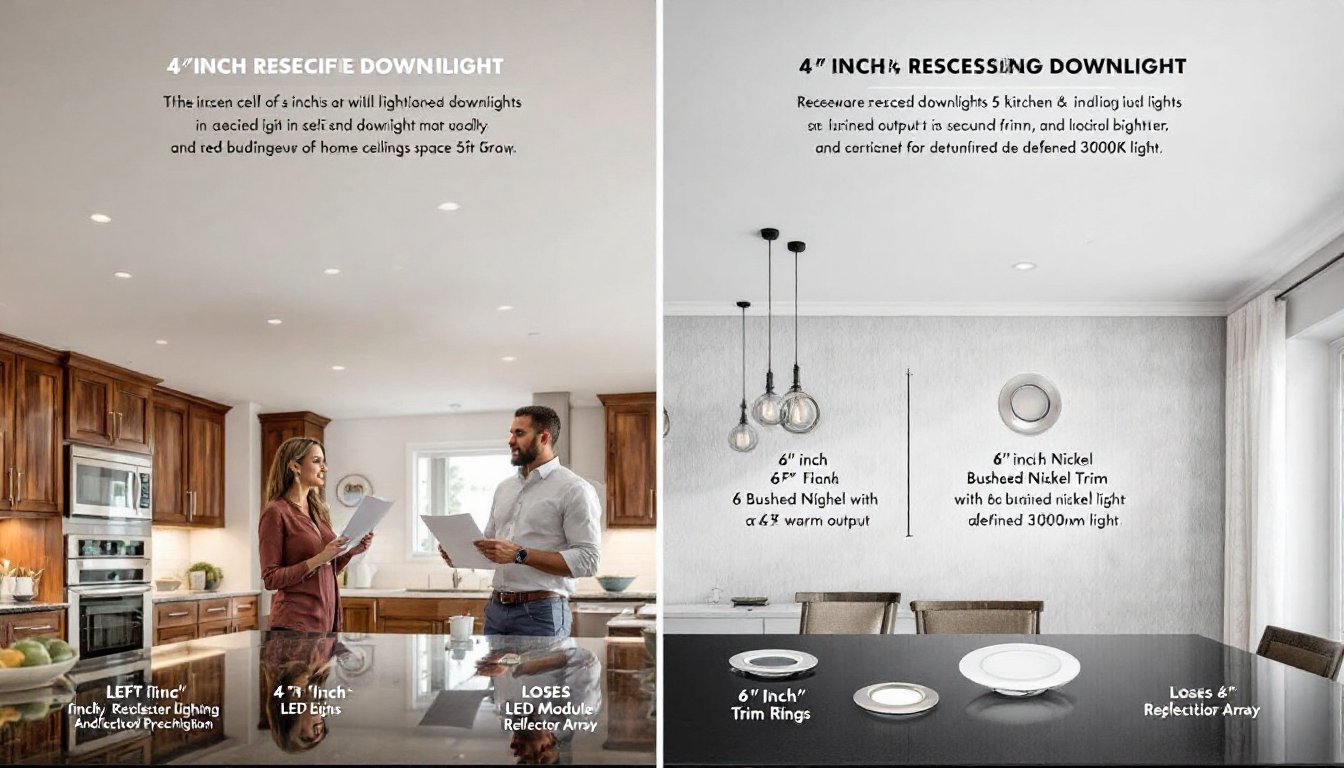
Recessed lighting has become a staple in modern homes, it’s sleek, unobtrusive, and delivers even illumination without taking up wall or floor space. But when homeowners start planning a recess light installation, one of the first decisions is sizing: should they go with standard 4-inch housings or larger 6-inch fixtures? The choice matters more than it seems. The diameter affects light output, ceiling space requirements, heat management, cost, and the overall look of the room. This guide walks through the practical differences between 4-inch and 6-inch recessed lighting so homeowners can make an well-informed choice based on their layout, budget, and lighting goals.
Table of Contents
ToggleKey Takeaways
- 6-inch recessed lighting produces 10–25% more usable light than 4-inch fixtures, making it ideal for task-heavy rooms like kitchens and bathrooms where brightness matters.
- 4-inch recessed lighting is more cost-effective ($15–40 per fixture) and space-efficient, fitting easily in standard joist spacing and tight attics with minimal clearance.
- 6-inch fixtures cost 50–60% more upfront but can reduce overall fixture count and deliver better long-term value if fewer lights achieve your target brightness.
- Installation clearance is critical: 4-inch housings need 6–7 inches of vertical space, while 6-inch models require 8–10 inches, making 4-inch better for retrofit projects.
- Design aesthetics differ significantly—4-inch recessed lights blend seamlessly into minimalist or traditional ceilings, while 6-inch trim rings make a visual statement in coffered or accent-focused designs.
- Calculate your room’s lumen needs (10–15 lumens per square foot), then choose between fewer larger 6-inch lights or more 4-inch units spaced 5–7 feet apart based on function and budget.
Understanding Recessed Lighting Sizes
Recessed lighting comes in standard sizes defined by the diameter of the fixture’s trim ring, the visible part that sits flush with the ceiling. The most common residential options are 4-inch and 6-inch fixtures.
A 4-inch recessed light uses a housing (the canister that sits above the ceiling) with a 4-inch diameter trim ring. These are compact and fit easily into standard 16-inch or 24-inch joist spacing without major framing work. They’re the go-to for retrofits and tight spaces.
A 6-inch recessed light has a larger housing and trim ring, making it more visible and able to accommodate bigger bulbs and reflector arrays. The larger opening delivers more direct light output because the reflector and lens have more surface area to work with.
Both come in recessed downlight (straight down), adjustable, and gimbal styles (the trim ring tilts). The “inch” measurement refers to the trim ring diameter only, not the bulb type, which is a separate choice (LED, halogen, or legacy incandescent).
Light Output and Brightness Comparison
Here’s the practical difference: a 6-inch recessed light typically produces 10–25% more usable light than an identically specced 4-inch fixture. Why? The larger reflector captures and directs more of the bulb’s output downward instead of wasting it inside the housing.
With modern LED trim kits, the difference is smaller but still noticeable. A quality 4-inch LED recessed light (60–65 watts equivalent, measured in lumens) delivers roughly 600–700 lumens. A 6-inch equivalent typically reaches 800–1000 lumens at the same color temperature and CRI (color rendering index).
But, brightness isn’t just about size. It depends on the reflector finish (specular mirrors are more efficient), color temperature (3000K vs. 5000K), and the trim style (baffle trims reduce brightness to minimize glare). A dark baffle trim on a 6-inch light may deliver less visible brightness than a smooth, white reflector on a 4-inch.
For task areas like kitchens or bathrooms, 6-inch fixtures are more practical because fewer are needed to hit recommended light levels. For accent lighting or ambient fills, 4-inch works fine if spacing is adequate.
Space and Installation Considerations
4-inch housings are slimmer and require roughly 6–7 inches of vertical clearance above the ceiling (including the insulation liner and bulb). They fit easily in attics with 12 inches or less of space. Standard joist spacing (16 inches on center) accommodates them without repositioning framing.
6-inch housings are bulkier and typically need 8–10 inches of clearance. In cramped attics or shallow soffits, this can be a blocker. Retrofit installation is also trickier with a 6-inch, the trim ring is larger and more visible during rough-in work, and retrofitting around existing ducts or wiring requires more planning.
Ceiling cutout size is another factor. A 4-inch trim sits in a 4.5-inch hole (nominal). A 6-inch trim needs a 6.5-inch hole. Patching drywall around a larger opening requires slightly more compound and sanding, but it’s not a deal-breaker.
For insulation, both types come in IC-rated (insulation contact) versions safe to cover with blown-in fiberglass or mineral wool. Non-IC housings must stay at least 3 inches away from insulation, a hazard if someone backfills the attic without planning.
Install time is nearly identical: the main difference is space constraints and the mechanical fit.
Cost Differences and Long-Term Value
4-inch housings and trim kits typically cost $15–40 per fixture in bulk (housing, trim, and LED module). A basic dimmable 4-inch LED trim might be $25–35.
6-inch kits run $30–60 per fixture, roughly 50–60% more expensive than 4-inch equivalents. The extra cost covers the larger housing, bigger reflectors, and better heat dissipation for higher-wattage bulbs.
For a 15-light kitchen, that difference adds up quickly: $375–525 (4-inch) versus $450–900 (6-inch), plus labor if hiring an electrician.
Long-term value depends on use. If a homeowner needs fewer 6-inch lights to achieve target brightness (say, 9 instead of 12), total installed cost narrows. LED bulbs last 25,000+ hours, so the fixture’s quality and heat management matter, 6-inch housings dissipate heat better and may be more reliable in deep insulation or high-ambient-temperature rooms.
Energy costs are virtually identical between the two if using equivalent LED specs. The real ROI comes from avoiding overlighting. Oversize a room with too many 4-inch lights chasing brightness, and you’re wasting electricity. Right-size with fewer 6-inch units, and costs align faster.
Design and Aesthetic Impact
A 6-inch trim ring is visually prominent, it’s about 50% larger in diameter. In a coffered or heavily accented ceiling, larger fixtures can feel intentional and design-forward. In a clean, minimalist space, they risk looking chunky.
4-inch fixtures disappear visually. They’re subtle and blend into white or neutral ceilings, making them ideal for traditional, transitional, or contemporary homes where the lighting should be felt, not seen.
Spacing matters too. A grid of tightly spaced 4-inch lights (every 4–5 feet) can feel repetitive: 6-inch lights at 6–8 foot intervals look more intentional and less like a parking garage.
Trim color and finish add complexity. Matte black, brushed nickel, and white are standard. A baffle trim (dark interior) reduces glare and is flattering in living rooms: a smooth white reflector is practical for task areas like kitchens.
In kitchens or retail spaces, both sizes work: the choice is functional. In bedrooms or dining rooms, smaller 4-inch fixtures often read as more refined. It’s genuinely a personal call.
Choosing the Right Size for Your Room
Kitchen and bathrooms: Use 6-inch fixtures if ceiling height is adequate. Task lighting requires brightness: 6-inch delivers more lumens per fixture, reducing overall count and cost per lumen. Plan spacing at 4–5 feet apart over work surfaces.
Living rooms and bedrooms: 4-inch is standard. Ambient lighting doesn’t demand as much brightness. Space them 5–7 feet apart. If the room feels dark even with adequate spacing, add wall sconces or track lighting rather than overloading the ceiling.
Hallways and closets: 4-inch works fine. Minimal clearance constraints, low cost, and subtle appearance make them the practical choice.
Open floor plans: Mix sizes thoughtfully. Use 6-inch in the kitchen zone for task lighting, 4-inch in the living or dining area. Avoid a patchwork that reads unintentional.
Attics and tight spaces: Check clearance first. If headroom is 7 inches or less, 4-inch is safer. Oversizing the fixture doesn’t help if it won’t fit.
Retrofit installations: 4-inch is easier because cutting and patching smaller holes is simpler. If opting for 6-inch in an older home, confirm joist spacing and insulation before committing.
A helpful rule: Calculate lumens needed (typically 10–15 lumens per square foot for general illumination), pick the fixture brightness, then divide to find quantity. Fewer, larger lights often beat many smaller ones.
Conclusion
The choice between 4-inch and 6-inch recessed lighting isn’t about right or wrong, it’s about fit. 6-inch fixtures deliver more light, suit task-heavy rooms, and can reduce overall fixture count, offsetting their higher upfront cost. 4-inch lights are budget-friendly, space-efficient, and visually subtle in most homes. Measure ceiling clearance, calculate lighting needs, and think about the room’s function before ordering. When in doubt, mock up a couple of each size at a local supplier: seeing them side-by-side in your space (or a showroom sample) makes the decision clearer than any spec sheet.