
Commercial pendant lighting has become a cornerstone of modern business design, from casual cafés to corporate offices and retail showrooms. These suspended fixtures offer far more than ambient illumination: they define a space’s aesthetic, influence customer behavior, and impact energy costs. Unlike residential pendant lighting, commercial options must balance style with durability, safety standards, and practical maintenance in high-traffic environments. Whether a business owner is renovating a workspace or building from scratch, understanding the nuances of commercial pendant lighting helps ensure the investment performs, visually and functionally, for years to come.
Table of Contents
ToggleKey Takeaways
- Commercial pendant lighting improves customer experience, employee productivity, and brand perception while meeting electrical codes and safety certifications required for business environments.
- Industrial and contemporary styles dominate modern commercial spaces; industrial fixtures convey authenticity in breweries and restaurants, while contemporary pendants with integrated LED technology suit modern offices and tech startups.
- Proper suspension height is critical—18 to 24 inches below standard 9–10 foot ceilings for most spaces, or 12 to 15 inches above work surfaces in kitchens and bars to reduce glare and provide task lighting.
- LED pendants recover their higher upfront cost ($100–$200 premium) within 2–3 years through 15–25% energy savings and minimal maintenance, plus potential utility rebates.
- Verify UL or ETL certifications, choose durable materials like powder-coated steel or anodized aluminum, and prioritize fixtures with 90+ CRI for accurate color rendering in retail and hospitality settings.
- Commercial pendant lighting installation requires licensed electricians ($200–$600 per fixture in labor) to ensure code compliance, proper wiring capacity, and ceiling structural support—never a DIY project.
What Is Commercial Pendant Lighting and Why It Matters
Commercial pendant lighting refers to suspended light fixtures designed for business environments. These fixtures hang from ceilings via cord, chain, or rod and deliver focused or ambient light depending on the design. Unlike table lamps or wall sconces, pendants offer flexibility in placement and create visual interest without consuming floor or counter space.
Why does it matter? Because lighting directly affects customer experience, employee productivity, and brand perception. Properly lit retail displays attract shoppers: warm, welcoming light in restaurants encourages lingering and repeat visits. Bright, flicker-free lighting in offices reduces eye strain and boosts focus. Also, commercial pendants must meet electrical codes, primarily the National Electrical Code (NEC), and often require certifications for wet or damp locations if installed in kitchens, restrooms, or entryways. A pendant light that looks great but fails code inspection becomes an expensive retrofit.
Commercial-grade pendants are engineered for heavier use: reinforced hardware, durable materials like powder-coated steel or brushed aluminum, and bulbs rated for frequent on/off cycles. Residential pendants, by contrast, may lack the durability or certifications required in public-facing spaces. Choosing commercial-spec fixtures from the start prevents costly replacements and ensures compliance.
Key Design Styles and Applications for Modern Businesses
Industrial and Contemporary Options
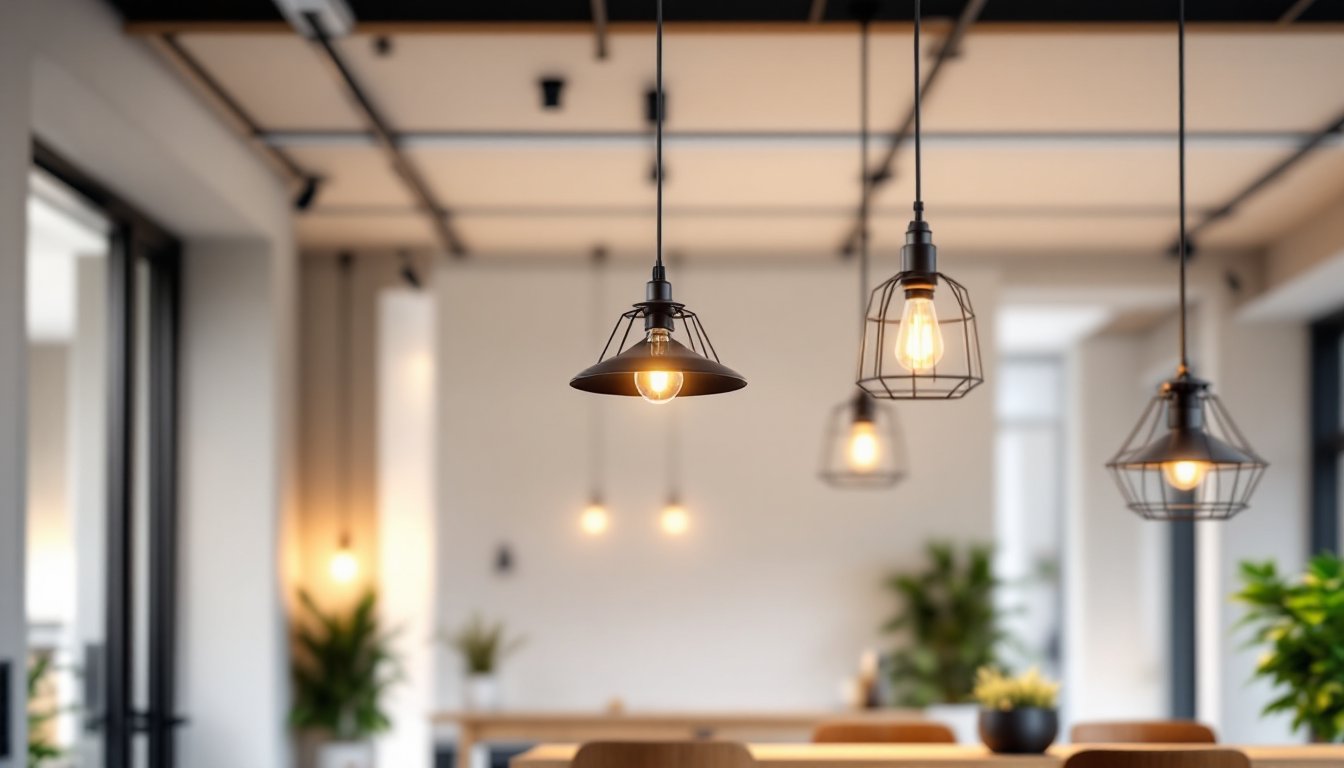
Industrial pendant lighting dominates modern commercial spaces. These fixtures typically feature raw materials, exposed metal, often steel or cast iron, minimal ornamentation, and a no-nonsense aesthetic. Popular industrial styles include dome shades, wire-frame cages, and clear-glass pendants with visible Edison bulbs. This look works exceptionally well in breweries, co-working spaces, and urban restaurants because it conveys authenticity and approachability.
Contemporary commercial pendants lean toward minimalism: clean lines, neutral finishes (matte black, brushed nickel, white), and geometric shapes. These fit seamlessly into modern offices, tech startups, and upscale boutiques. Many contemporary pendants integrate integrated LED technology, eliminating the need for separate bulbs and offering dimming controls that traditional fixtures can’t match. A contemporary pendant with built-in LEDs often costs more upfront but saves on maintenance labor and energy bills over a 3–5-year cycle.
Hospitality and Retail Solutions
Hospitality design, hotels, bars, restaurants, calls for pendants that create ambiance while maintaining function. Warm color temperatures (2700K to 3000K) mimic candlelight and encourage relaxation. Materials like brushed brass, warm copper, and frosted or tinted glass add sophistication. A restaurant might use adjustable-height pendants over bar seating to create intimate zones while keeping the main dining area brighter and more open.
Retail pendants serve dual purposes: highlighting merchandise and creating an inviting store atmosphere. Track-mounted or articulating pendants allow store layouts to flex without rewiring. Clear-glass or open-design pendants prevent shadows that hide product details. Many retail installations use 3000K to 4000K color temperature for better color rendering, especially crucial for apparel, art, or jewelry. A boutique selling high-end fashion, for instance, needs pendants that reveal true fabric colors and prevent unflattering shadows on displays.
Choosing the Right Fixtures for Your Space and Budget
Start by measuring your ceiling height and the area each pendant will illuminate. A standard commercial ceiling is 9 to 10 feet: pendants hung 18 to 24 inches below the ceiling work for most spaces. In kitchens or above bar counters, suspend pendants 12 to 15 inches above work surfaces to avoid glare and provide task lighting.
Budget matters, but it’s not just about fixture cost. Factor in labor, wiring upgrades if needed, and controls. A basic industrial pendant might run $80–$150 per unit in bulk: high-end contemporary or specialty hospitality fixtures can reach $300–$800 each. LED integration typically adds $100–$200 to the price but recovers through energy savings in 2–3 years.
Consider the following when selecting fixtures:
- Mounting type: Pendant stem, chain, or cable. Chain offers adjustability: rigid stems suit modern aesthetics: cable systems work in open lofts or where flexibility is key.
- Material durability: Powder-coated steel resists rust and fingerprints: anodized aluminum works well in humid environments (near sinks or entryways): brass develops patina over time but adds character.
- Bulb compatibility: LED-only fixtures are increasingly standard. Halogen or incandescent pendants generate heat (problematic near flammable materials or in summer cooling-heavy climates) and cost more to operate.
- Certification: Look for UL (Underwriters Laboratories) or ETL (Intertek) marks for electrical safety. For wet locations (kitchens, bathrooms), verify the fixture is rated damp or wet.
When comparing quotes, ensure you’re comparing like fixtures. A $120 pendant without integrated dimming isn’t the same value as a $200 pendant with built-in LED and wireless control capability.
Installation, Maintenance, and Energy Efficiency Considerations
Installation of commercial pendant lighting requires licensed electricians in most jurisdictions, this isn’t a DIY project. Ceiling penetration, junction boxes, and hardwiring must meet code. A professional electrician will inspect existing wiring capacity, determine if a new circuit is needed, and ensure the ceiling structure can support the fixtures. This often costs $200–$600 per fixture in labor, depending on wiring complexity and location.
Maintenance is straightforward if you choose the right fixtures. Dust pendants monthly using a soft cloth or brush to prevent light output degradation. For bulb-based pendants, schedule replacements on a calendar: group replacements save labor costs. LED fixtures need almost no maintenance except occasional cleaning. Built-in dimming controls and occupancy sensors can reduce energy use by 15–25% compared to on/off switching alone.
Energy efficiency is a major advantage of commercial LED pendants. A traditional 60W incandescent pendant costs roughly $0.07 per hour to operate (at $0.12/kWh). An equivalent LED pendant drawing 9W costs about $0.001 per hour. Over 40 hours per week for a year, that’s a savings of $130 per fixture. Many jurisdictions offer rebates for commercial LED upgrades: check with local utilities.
One often-overlooked detail: color rendering index (CRI). LED pendants with 90+ CRI render colors more accurately than lower-CRI alternatives. In hospitality or retail, this difference is visible and worth the slight upcharge. A pendant listed as “3000K, 90+ CRI” will flatter products and create warmth better than a generic “warm white” fixture.
Conclusion
Commercial pendant lighting is an investment in both aesthetics and function. The right fixture elevates a business space, setting the tone for customer experience, supporting employee productivity, and reducing operational costs through efficient, durable design. By understanding design styles, sizing pendants correctly, and prioritizing LED technology and proper installation, businesses position themselves for long-term success. Take time to evaluate options, consult a licensed electrician on code and feasibility, and choose fixtures that align with both brand identity and budget constraints.