
Good bathroom lighting isn’t an afterthought, it’s the difference between squinting at the mirror during your morning routine and actually seeing what you’re doing. Vanity lighting ideas range from simple single-fixture setups to layered schemes that rival professional salons. The right vanity lighting reduces shadows, flatters skin tone, and makes grooming tasks easier and safer. Most homeowners underestimate how much a lighting upgrade can improve both function and ambiance in their most-used bathroom spaces. Whether you’re replacing an aging Hollywood-style fixture or installing sconces for the first time, understanding lighting placement, wattage, and color temperature will help you get it right the first time.
Table of Contents
ToggleKey Takeaways
- Vanity lighting ideas should aim for 50–150 foot-candles at the mirror surface with a color temperature of 3000K–4000K to balance visibility with flattering illumination.
- Mount a single vanity light bar 18–24 inches above the mirror at two-thirds its width, or position sconces 60–65 inches from the floor and 18–24 inches from the mirror’s centerline for balanced, shadow-free lighting.
- LED vanity fixtures with CRI ratings of 90+ generate less heat, last 25,000+ hours, and reduce energy use by 80% compared to incandescent bulbs while maintaining professional-quality light.
- Layer task, ambient, and accent lighting with dimmer controls to create flexibility, allowing you to shift from bright morning grooming light to softer evening ambiance.
- Hollywood-style and smart vanity lighting provide dramatic results but require dedicated 20-amp circuits and professional installation, making them premium upgrades worth budgeting for carefully.
Why Proper Vanity Lighting Matters
Bathroom vanity lighting serves two jobs: it has to illuminate the mirror evenly without casting shadows across the face, and it needs to provide enough light for precise tasks like shaving, makeup application, or contact lens insertion. Poor vanity lighting creates dark pockets above the eyebrows and under the chin, exactly where detail work suffers most. The National Electrical Code (NEC) doesn’t specify minimum bathroom lighting levels, but industry standards suggest 50 to 150 foot-candles at the mirror surface depending on the task. For reference, general bathroom ambient lighting typically sits around 30 foot-candles.
Color temperature matters just as much as brightness. Light that’s too warm (below 2700K) can hide imperfections but feels dingy during the day. Light that’s too cool (above 5000K) mimics daylight and shows everything, which is honest but sometimes unflattering. Most vanity setups aim for 3000K to 4000K (warm white to neutral white) to balance visibility with a flattering appearance. Proper vanity lighting also reduces eye strain, improves safety when handling sharp grooming tools, and sets the mood for a more spa-like bathroom experience overall.
Classic Mirror-Mounted Fixtures
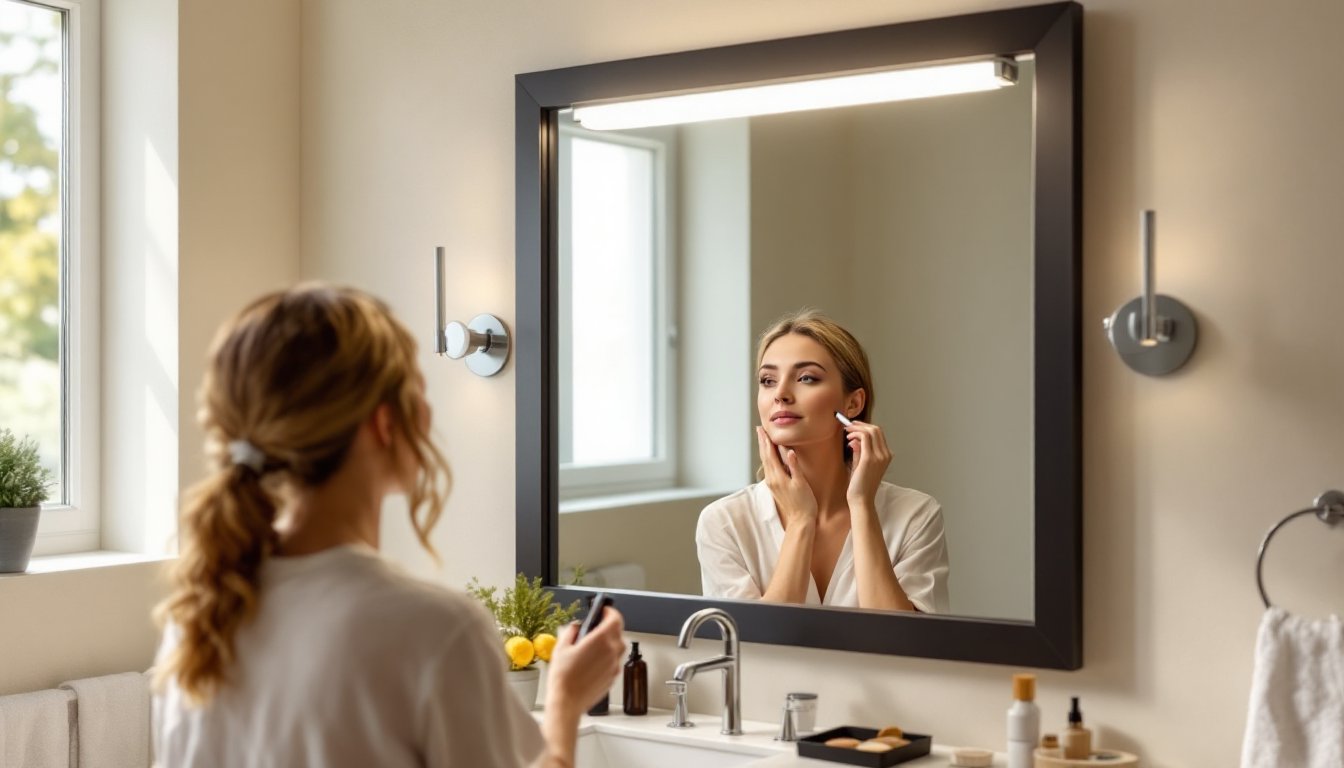
A single vanity light bar mounted directly above the mirror remains the most straightforward and budget-friendly approach. These fixtures typically span 24 to 48 inches and mount flush or semi-flush to the wall directly above the mirror frame. For a standard bathroom mirror (36 to 48 inches wide), choose a light bar that’s about two-thirds the mirror width, this keeps proportions balanced and ensures even light distribution.
When installing above the mirror, mount the fixture 18 to 24 inches above the mirror’s top edge. Too close and it casts harsh shadows: too far and light diffuses before reaching the face. Most bathroom code requires a minimum of 12 inches of clearance between the fixture and the shower enclosure or tub edge for safety. Use GFI-protected circuits (ground fault interrupt) for all bathroom outlet and light wiring per NEC requirements.
For fixtures with exposed bulbs, use frosted or diffused bulbs (never clear) to reduce glare and harsh shadows. LED vanity bars offer better light quality than older incandescent options and run cooler, important in smaller bathrooms where heat buildup matters. If you’re retrofitting an older fixture, expect to run new electrical wire through the wall. This isn’t a quick swap: budget time for drywall access, wire routing, and possibly a licensed electrician if you’re uncomfortable working inside walls.
Modern Sconce Arrangements
Two or more wall-mounted sconces flanking the mirror create more balanced, flattering light than a single overhead bar. This arrangement softens shadows and provides better visibility for detailed grooming. Mount sconces 60 to 65 inches from the floor (roughly eye level when standing at the sink) and position them 18 to 24 inches from the mirror’s centerline on each side. This spacing prevents light from bouncing directly back into your eyes while illuminating the face from the sides.
Sconces work especially well in larger bathrooms (48+ inches wide) where a centered bar would leave corners dim. They also create visual interest on the wall and can match various décor styles. Popular options include modern geometric shades, vintage Edison-bulb fixtures, and minimalist cylinder sconces. Ensure sconces have diffusing shades or frosted glass to prevent harsh glare. Some homeowners combine sconces with an overhead light for layered, restaurant-quality illumination.
Installing sconces requires running electrical wire horizontally through the wall at the chosen height. If your bathroom doesn’t have existing outlets at sconce height, this means opening drywall, running new cable, and patching afterward. For renters or those avoiding wall work, plug-in sconces with long cords exist, though they’re less elegant and more visible.
Hollywood and Glam-Style Lighting
Hollywood vanities, mirrors surrounded by individual exposed bulbs in sockets (often mounted in a circular or rectangular frame), deliver dramatic, high-wattage illumination. They’re statement pieces that work best in larger bathrooms with room to spare around the mirror. Each bulb typically runs 40 to 60 watts, and a frame with 12+ bulbs provides 480+ watts of light, enough to rival professional makeup stations.
These fixtures need honest assessment before installation. They consume significant power, generate considerable heat, and demand proper ventilation to prevent moisture damage and bulb lifespan issues. Many older Hollywood fixtures use incandescent or halogen bulbs: upgrading to LED equivalents (roughly 8-10W LED per 60W incandescent) cuts energy use by 80% while maintaining the aesthetic. The heat reduction also helps with longevity, LED bulbs last 25,000+ hours versus 1,000 hours for incandescent.
Installation requires a dedicated 20-amp circuit for safety and code compliance, especially with that much wattage. Expect to hire a licensed electrician if your bathroom doesn’t already have the electrical capacity. The visual payoff is undeniable, these fixtures photograph well, provide studio-quality lighting, and feel luxurious. But they’re not a DIY shortcut: plan on professional help and budget accordingly.
Energy-Efficient and Smart Lighting Solutions
LED vanity fixtures have matured dramatically over the past five years. Modern LED bars deliver CRI (color rendering index) ratings of 90+, meaning colors look natural and true to life, critical for makeup or skincare routines. They produce less heat than halogen or incandescent fixtures, which matters in enclosed bathrooms where moisture and heat can degrade finishes and shorten bulb lifespan.
Smart vanity lights with dimming controls and adjustable color temperature are becoming mainstream. A dimmer lets you shift from bright task lighting during morning routines to softer accent lighting in the evening. Some models include tunable white technology (adjustable color temperature from 2700K to 5000K) via a remote or smartphone app, letting you dial in the perfect light for different times of day or tasks. Expect to pay a premium, roughly $150 to $400 for a quality dimmable LED vanity bar versus $40 to $80 for a basic non-smart fixture.
If retrofitting a smart fixture feels overwhelming, consider a simpler upgrade: install a standard dimmer switch with existing sconces or bars. This costs under $30 and provides flexibility without app syncing. Always verify that your chosen LED fixture is dimmable-compatible before purchase: not all LEDs play nicely with older dimmer switches. Pay attention to wattage ratings, a dimmer rated for 600W won’t safely handle 1200W of load, so total fixture wattage must stay within the dimmer’s rating.
Layering Light for Optimal Results
Professional designers use a three-tier lighting approach: task, ambient, and accent light. Task lighting is your vanity fixture, bright, focused illumination for grooming. Ambient lighting (often a ceiling-mounted fixture or soffit) provides general bathroom brightness. Accent lighting (optional wall sconces, LED strips behind the mirror) adds visual interest and mood.
Combining these layers creates flexibility. Imagine your vanity bar at full brightness for morning routine, but dimmed to 30% alongside accent LEDs for evening wind-down. This requires separate circuits or smart controls to manage independently. A practical setup: install your primary vanity fixture on one dimmer switch and the ceiling light on a separate standard switch. This lets you adjust task lighting intensity while keeping ambient light steady.
Backlighting the mirror with LED tape (thin adhesive strips of LEDs) creates a halo effect that softens the overall space. These strips cost $20 to $50 and stick directly to the mirror frame or wall: they’re nearly invisible when off. Neutral white (3000K) or cool white (4000K) tape works best behind mirrors, as warm tones read as orange in this context.
Layering also accounts for daylight. A bathroom with a window should have adjustable artificial lighting that complements natural light at different times of day. A dimmer on your vanity fixture handles this elegantly, bright in early morning or evening, reduced during midday when daylight fills the space.
Conclusion
Vanity lighting doesn’t have to be complicated. Start by honestly assessing your current setup: are shadows or dark spots a problem? Does light distribution feel even? From there, match your budget and skill level to the right solution. A simple LED bar above the mirror solves most issues. Sconces, Hollywood fixtures, or smart controls are next-level upgrades worth considering if you’re already planning bathroom work. Whatever route you choose, prioritize proper placement, adequate brightness (50–150 foot-candles), and warm-to-neutral color temperature (3000K–4000K). The payoff, safer grooming, better mood, and a more polished bathroom, is worth the investment.